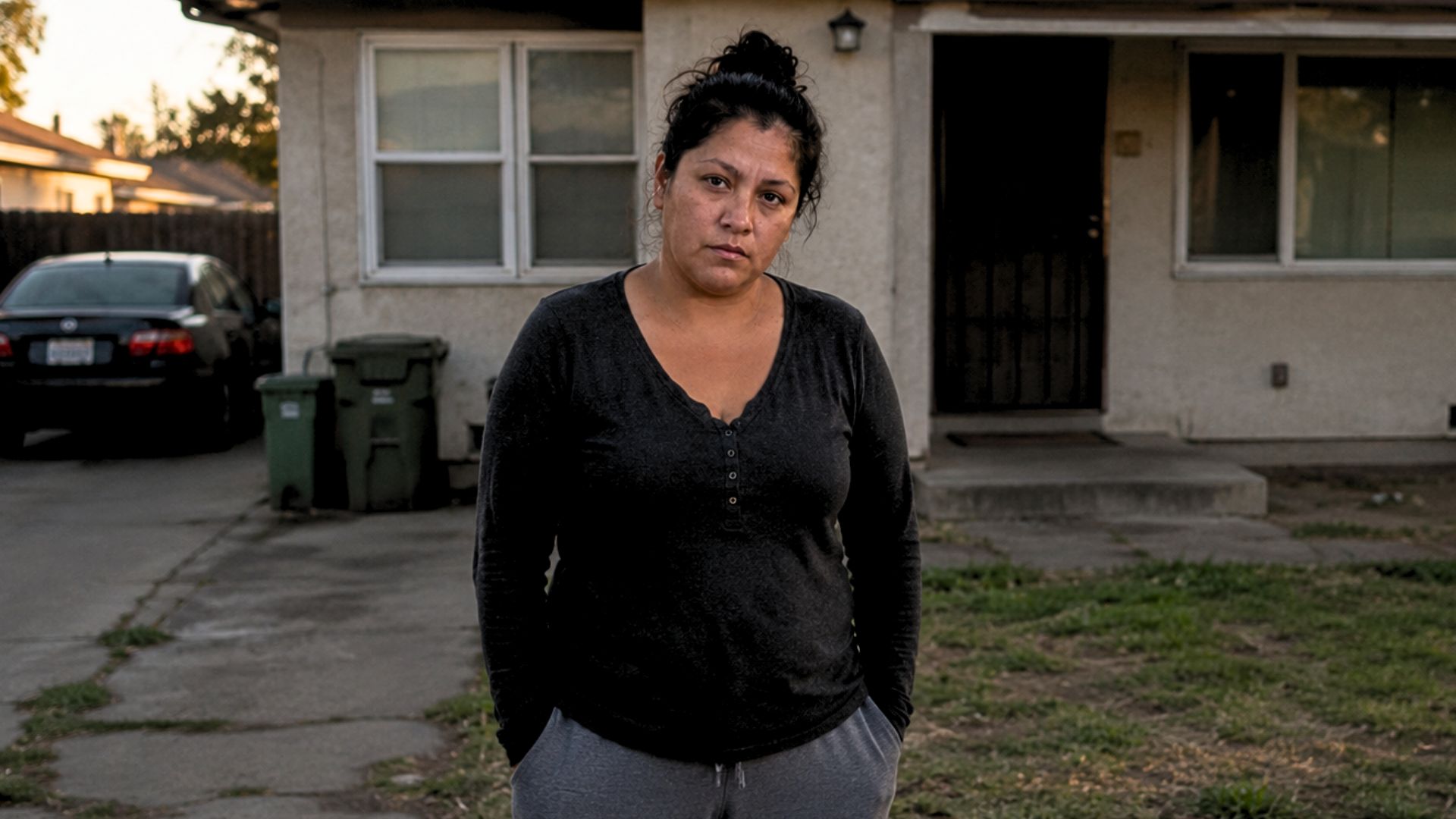

By the time Denise Alvarez opens the rental listings, the rest of her apartment is quiet.
The dishes are stacked. Her son’s backpack is by the door. Her mother, who moved in after a fall last winter, is asleep in the living room, where the couch now doubles as a bed. Denise sits at the kitchen table in South Natomas with her phone in one hand and a yellow notepad in the other, writing down numbers that no longer seem to belong to the city where she grew up.
One-bedroom. $1,700.
Two-bedroom. $2,100.
Three-bedroom. Don’t even look.
“I don’t need a dream house,” Denise said. “I just need a door my family can keep opening.”
That is what Sacramento’s housing crisis looks like for many people now. Not always an eviction notice. Not always a tent. Often it is a quiet nightly calculation: rent, groceries, gas, child care, utilities, one old medical bill, one car repair that can ruin the month.
Sacramento is still cheaper than San Francisco, San Jose or Los Angeles. That comparison is part of the city’s public identity. But for many local renters and first-time buyers, Sacramento no longer feels affordable. It feels like a place where the numbers changed faster than the people living here could.
The city’s median household income was $87,321 from 2020 to 2024, according to the U.S. Census Bureau. Its median gross rent was $1,779. The median value of owner-occupied housing units was $506,300. Those are broad figures, but they tell a simple story: Sacramento wages and Sacramento housing prices are not living in the same decade.
Rent is no longer the easy option
For years, renting was the fallback. If buying was too expensive, a family could rent, save and wait. That logic has weakened.
As of June 2026, the average apartment rent in Sacramento was $1,899, according to RentCafe. A studio averaged $1,580. A one-bedroom averaged $1,693. A two-bedroom averaged $1,963. A three-bedroom averaged $2,634.
For a single renter, those numbers are heavy. For a parent, they can be defining.
The common affordability rule says housing should take no more than 30% of monthly income. At Sacramento’s median household income, that works out to about $2,183 a month before utilities, insurance, debt and other costs. That may cover the average two-bedroom on paper. It does not easily cover a three-bedroom. It does not help a worker earning below the median. It does not account for child care. It does not account for a household trying to save.
Denise knows this in a less formal way. She knows it because every apartment search begins with hope and ends with subtraction.
“I used to search by neighborhood,” she said. “Now I search by what I can survive.”

RentCafe neighborhood data shows why that search narrows quickly. Downtown Sacramento averaged $2,120. Midtown-Winn Park-Capital averaged $2,301. Natomas Crossing averaged $2,549. Even if cheaper neighborhoods remain, affordability increasingly depends on tradeoffs, longer drives, older buildings, fewer bedrooms, fewer options near school or work.
The countywide picture is more severe for low-income households. The California Housing Partnership’s 2026 Sacramento County report found that 50,915 low-income renter households did not have access to an affordable home in 2024. It also found that 86% of extremely low-income households were paying more than half their income toward housing costs.
That is not a tight budget. That is a budget with no weather in it. No broken tire. No missed shift. No sick child.
Buying is even further away
For renters hoping to buy, the ladder has pulled upward.
Zillow put the typical Sacramento home value at $481,741 as of May 31, 2026. The median sale price was $469,000, and the median list price was $502,663. Homes were going pending in about 12 days, and 45.5% of sales were still closing over list price.
Even after recent price cooling, the entry point remains steep. A 20% down payment on a $481,741 home is about $96,000. That is before closing costs. Before repairs. Before moving. Before furniture. Before the first surprise bill that comes with owning something old enough to need care.
Then comes the mortgage rate.
Freddie Mac reported that the 30-year fixed mortgage averaged 6.52% as of June 11, 2026. On a typical Sacramento home with 20% down, the principal and interest alone would be roughly $2,440 a month. Taxes, insurance and other costs push the real monthly payment higher.
For a household making Sacramento’s median income, buying a home may still be mathematically possible in some cases. But possible is not the same as stable. Possible is not the same as safe. Possible is not the same as being able to pay for braces, save for college, replace a transmission or help an aging parent.
Denise used to keep a folder labeled “house.” Inside were screenshots of small bungalows, lender emails, a few handwritten savings goals. She stopped opening it last year.
“I didn’t throw it away,” she said. “I just stopped pretending the math was close.”
Sacramento is building, but not fast enough
City officials know supply is part of the problem. Sacramento’s latest housing production report shows the city produced 2,737 housing units in 2025, a 14.7% increase from 2024. That is progress.
But the same report says the city needs to average 5,698 units per year to meet its state housing target of 45,580 units by 2029. The 2025 total was only about 48% of that annual pace.
The city also produced 930 affordable units and permitted 390 accessory dwelling units in 2025. Those numbers matter. Every affordable unit matters to someone. Every backyard apartment can become a home for a relative, a student, a worker or a senior.
But the gap is larger than any single program.
The city’s eight-year housing target is not just a planning document. It is a measurement of how many homes Sacramento is expected to need across income levels. Falling short does not show up only in a spreadsheet. It shows up when a family stays doubled up. When a teacher lives in another county. When a senior waits years for subsidized housing. When a renter accepts a rent increase because moving would cost even more.
The crisis is regional, but the pain is local
Sacramento’s affordability problem does not exist in isolation. The California Legislative Analyst’s Office reported in April 2026 that California mid-tier homes were about $775,000, more than twice the cost of typical mid-tier homes nationally. The LAO also found that only about 23% of California households would likely qualify for a mortgage on a mid-tier home in 2026, down from about 31% in 2019.
The statewide pressure pushes people around the map. Families priced out of the Bay Area look inland. Sacramento residents look to Elk Grove, Rancho Cordova, Woodland, Yuba City or farther. Then those places get more expensive, too.
The LAO described another problem: mortgage lock-in. As of September 2025, about 77% of California homeowners had mortgage rates below 5%, while new buyers faced much higher rates. That gives many current homeowners a strong reason not to sell, limiting the supply of homes available to buyers.
So Sacramento gets stuck from both sides. Renters cannot easily buy and owners cannot easily move. Builders face costs, financing, delays and neighborhood resistance. Affordable housing developers depend on complicated stacks of public funding, tax credits and land deals.
Meanwhile, people like Denise wait.
Housing pressure touches everything else
Housing affordability is often treated as a housing department issue. It is bigger than that.
It affects schools because families move when rent rises. It affects employers because workers cannot live near jobs. It affects transit because cheaper housing is often farther from work. It affects public health because a household spending half its income on rent has less money for food, medicine and rest.
The California Housing Partnership found that renters in Sacramento County needed to earn $34.67 an hour to afford the average monthly asking rent of $1,803. That is 2.1 times the state minimum wage. The same report found asking rents in Sacramento County increased 17.1% between Q4 2020 and Q4 2025.
Those increases land differently depending on income. A state worker with savings may complain and adjust. A single parent may move. A senior may skip medication. A young adult may delay leaving home. A family already living paycheck to paycheck may have no room left.
Sacramento’s homelessness numbers show the outer edge of that pressure. The 2024 Point-in-Time Count estimated 6,615 people experiencing homelessness in Sacramento city and county. In 2026, CapRadio reported the count had risen to an estimated 7,458 people, up 13% from the 2024 count.
Not every person experiencing homelessness lost housing because of rent. Mental health, addiction, domestic violence, job loss, family breakdown and health crises all play roles. But high housing costs make every other problem harder to recover from.
Denise thinks about that when she sees tents near freeway ramps or people sleeping behind shopping centers. She does not see a separate crisis. She sees the same math, further down the road.
“There’s a line people think they’ll never cross,” she said. “But rent moves the line.”
What Sacramento does next
The city is not standing still. Sacramento has changed zoning rules, promoted accessory dwelling units, pushed housing streamlining and reported higher production in 2025. The region has more housing data than it once did. State law has also forced cities to plan for more homes.
But the question for residents is simpler than the policy language: Will the city become a place where working people can still stay?
That question does not have one answer. More housing helps, but only if it is built at the scale needed. Affordable housing helps, but only if funding keeps pace with the need. Tenant protections help, but they do not create enough homes on their own. Homeownership programs help, but they cannot overcome prices and interest rates by themselves.
Sacramento’s housing crisis is not only about scarcity. It is about timing. The city is trying to add homes after years of underbuilding, after a pandemic-era price surge, after interest rates rose, after rents reset higher, after many families already drained savings trying to keep up.
Denise still checks listings twice a week. She still keeps the yellow notepad. She still circles anything that looks possible.
But possible has become a smaller word.
She would like a second bedroom for her son. A little space for her mother. A rent that does not turn every month into a negotiation with groceries, gas and fear. She would like to stay in Sacramento without feeling as if the city is slowly asking her to leave.
“I’m not trying to get ahead,” she said. “I’m trying not to fall behind in the place I already belong.”