
Sacramento, California – Marcus Reed leaves his house before sunrise, not because his shift starts early, but because Sacramento traffic has taught him to fear the clock.
At 6:35 a.m., he is already backing out of the driveway in Meadowview, coffee in the cupholder, lunch on the passenger seat, one eye on the gas gauge and the other on the traffic app. His job near Natomas does not look far on a map. That is the part that bothers him most.
“It’s not Los Angeles,” Marcus said. “That’s what people keep saying. But I’m not driving in Los Angeles. I’m driving here. And here is getting worse.”
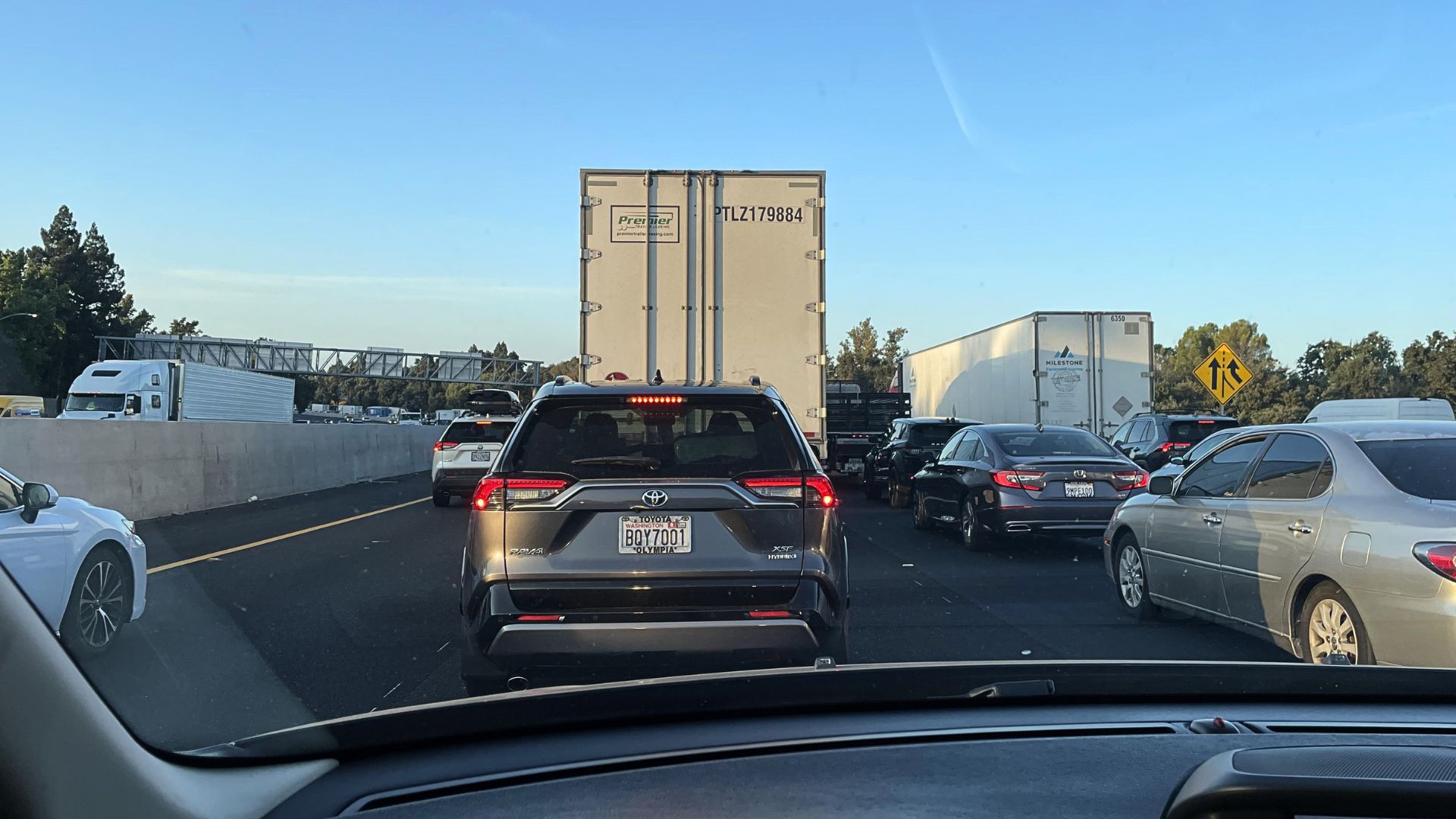
His morning route changes depending on the accident, the lane closure, the school drop-off line, the freeway ramp that backs up without warning. Some days he takes I-5. Some days he cuts over and regrets it. Some days the trip takes 28 minutes. Some days it takes almost an hour. By the time he parks, he says, he already feels as if he has worked a half shift.
That is the quiet transformation of traffic in Sacramento. It is no longer just a rush-hour complaint. It is a household issue, a safety issue, a planning issue and, for many working people, a daily tax paid in minutes, fuel, stress and missed time.
The U.S. Census Bureau puts Sacramento city’s mean travel time to work at 25.3 minutes for workers age 16 and older from 2020 to 2024. On paper, that does not sound unbearable. It is near the national norm. But averages smooth over the lived reality of a region where one crash on Highway 50, one backup near the W-X freeway, one lane closure on I-80 or one badly timed school commute can reshape a morning.
Data USA, using Census data, found that in 2024 64% of Sacramento workers drove alone, while 19.7% worked from home and 8.99% carpooled. The same source found that 3.24% of workers had “super commutes” of more than 90 minutes. Those are not just transportation statistics. They are family schedules.
Marcus feels that at 5:20 p.m., when his daughter’s soccer practice starts at 6 and the map says he will arrive home at 5:58. Of course, if nothing else goes wrong.
A city still built around the car
Sacramento has light rail. It has buses. It has bike lanes, regional trails and walkable pockets. But most daily life still depends on the car.
Countywide data from Be Healthy Sacramento shows that 502,290 Sacramento County workers drove alone, compared with 127,429 who worked at home, 71,103 who carpooled, 9,521 who used public transportation, 12,463 who walked and 4,813 who bicycled. In percentage terms, 67.89% of county workers drove alone, while just 1.29% used public transportation.
That means congestion is not just about bad drivers or poorly timed lights. It is about the basic design of daily life. Housing, jobs, schools, shopping centers and medical offices are spread across a region where many trips feel difficult without a car.
For Marcus, that means nearly every obligation becomes a drive. Work. Groceries. The pharmacy. His mother’s doctor appointment. His daughter’s practice. His son’s school event.
“I don’t take trips anymore,” he said. “I run missions.”
That kind of life adds up across the county. Be Healthy Sacramento reports an average county commute of 29 minutes. It also shows that 149,204 workers commute 30 to 44 minutes, 39,281 commute 45 to 59 minutes and 45,687 commute 60 minutes or more.
A one-hour commute is not just one hour. It is two hours a day, 10 hours a week, roughly 40 hours a month. For a full-time worker, that can feel like a second job without pay.
The rush hour that stretches
The old idea of traffic had a rhythm. Morning was bad. Evening was bad. The middle of the day gave the city room to breathe.
That rhythm is weaker now.
TomTom’s 2025 traffic index reported that Sacramento’s average congestion level was 32.8%, up 3.1 percentage points from 2024. It found the average travel time for a 10-kilometer drive was 11 minutes and 1 second, 26 seconds more than the previous year. During morning rush hour, a 10-kilometer trip took 12 minutes and 15 seconds. During evening rush hour, it took 15 minutes and 7 seconds, with an average congestion level of 69.2%.
TomTom estimated that Sacramento drivers lost 38 hours to rush-hour traffic in 2025, nearly four hours more than in 2024.
That number lands differently depending on the household. For some people, 38 hours is an inconvenience. For others, it is missed overtime, late child care pickup, less sleep, more gas, more stress and less patience by the time they get home.
Marcus says his children know the language of traffic now. They ask whether “the freeway is red.” They know that an accident means dinner moves later. They know that when their father walks in quietly, sets down his keys and stares at nothing for a few seconds, the road has followed him inside.
Construction is necessary. It still hurts.
Sacramento’s traffic frustration is not only about population growth or commuting patterns. It is also about repair.
Roads and freeways age. Bridges need work. Pavement fails. Major corridors need maintenance whether drivers like it or not. But the construction burden often falls on people who have no flexible schedule and no better route.
In 2025, SFGATE reported that Sacramento drivers were dealing with a trio of major projects, including work tied to Highway 50, the Yolo 80 Corridor Improvements Project and the Fix50 project, producing regular congestion in the area. The same report noted a planned full eastbound Highway 50 closure in West Sacramento from June 13 to June 17, 2025, as part of a pavement rehabilitation project, with Caltrans recommending alternate routes for Bay Area drivers heading toward Tahoe or Reno.
For regional travelers, that may be a weekend headache. For Sacramento residents, it becomes part of the week.
Marcus does not oppose road work. He understands the pavement has to be fixed. But he wonders why every improvement seems to arrive as another delay before it becomes a benefit.
“That’s what gets people,” he said. “They say it’ll be better later. But later doesn’t pick up your kid today.”
Traffic is also a safety crisis
Congestion gets most of the attention because everyone can feel it. But Sacramento’s road problem is also measured in injuries and deaths.
The California Office of Traffic Safety’s 2023 rankings listed Sacramento with 4,214 victims killed or injured in total fatal and injury collisions. Among 15 comparable cities, Sacramento ranked 2nd out of 15 for total fatal and injury victims. It ranked 1st out of 15 for alcohol-involved victims, with 454. It ranked 1st out of 15 for speed-related fatal and injury collisions, with 745. It reported 297 pedestrian victims and 237 bicyclist victims.
Those figures show a city where traffic is not just slow. It is dangerous.
Sacramento has already acknowledged this publicly. In 2017, the City Council adopted a Vision Zero goal to eliminate traffic fatalities and serious injuries by 2027. The city’s Vision Zero page says the effort is based on the idea that crashes are not just “accidents,” but preventable incidents that can be addressed through data, street design, policy and investment.
That 2027 deadline is now close.
The city says it began updating its Vision Zero Action Plan in 2025, with community workshops, events and surveys to shape the next phase. The work matters because the problem has not disappeared. Sacramento Bee reporting found that at least 32 people died in city crashes in 2025, similar to 33 deaths in 2024, and that traffic deaths averaged 38 per year from 2017 through 2025.
For Marcus, those numbers changed after a crash near his neighborhood killed a man he did not know but could easily imagine being.
“You see the flowers tied to a pole,” he said. “Then the next day everyone drives past like nothing happened.”
The cost is not shared evenly
Traffic affects almost everyone. It does not affect everyone equally.
A state worker with remote days can avoid the worst commute. A higher-income household can live closer to work. A parent with flexible hours can leave earlier or later. But a warehouse worker, medical assistant, restaurant employee, school staffer or construction worker may not have that choice.
The person who has to be on site at 7 a.m. pays for congestion with sleep. The person who cannot afford to live near work pays with gas. The person whose child care charges late fees pays twice. The person who relies on buses pays with time when service is limited or indirect.
That is why traffic is also an equity issue. A congested city forces residents to buy their way out if they can. Move closer. Work remotely. Change schedules. Pay for parking. Use delivery. Avoid certain trips.
People without those options sit in the same lanes longer.
Sacramento’s transportation future is often discussed through big words: mobility, sustainability, corridor planning, mode shift, infill development. Those words matter. But residents experience the issue in smaller ways.
Can I get to work on time? Can my child cross safely? Can the bus get me there without two transfers? Can I live near my job? Can I get home before bedtime?
What would make traffic better?
There is no single fix.
More lanes alone will not solve Sacramento’s traffic problem if growth keeps spreading outward and most people still need to drive. Transit alone will not solve it if service is not frequent, reliable and close enough to where people live. Bike lanes alone will not solve it if people do not feel safe using them. Remote work helps some workers, but not the people who keep hospitals, restaurants, warehouses, schools and city services running in person.
The answer is likely a combination: safer street design, better signal timing, serious speed enforcement, more reliable transit, more housing near jobs, protected bike routes, repair work that is coordinated clearly, and land-use choices that reduce the need for long daily drives.
That is slow work. It is also the kind of work that determines whether Sacramento becomes easier to live in or just bigger.
Marcus does not expect empty roads. He does not expect to drive from Meadowview to Natomas without stopping. He knows he lives in a growing capital city, not a small town frozen in time.
But he wants the city to notice what traffic is taking.
“It takes your morning,” he said. “Then it takes your mood. Then it takes time from your family. After a while, it feels like the road owns part of your life.”
On a recent typical day, Marcus made it home at 6:12 p.m. His daughter had already left for practice with a neighbor. Dinner was still in the freezer. His phone showed one crash, two slowdowns and a red line across the river.
The commute was over. The day, somehow, still had to begin again.