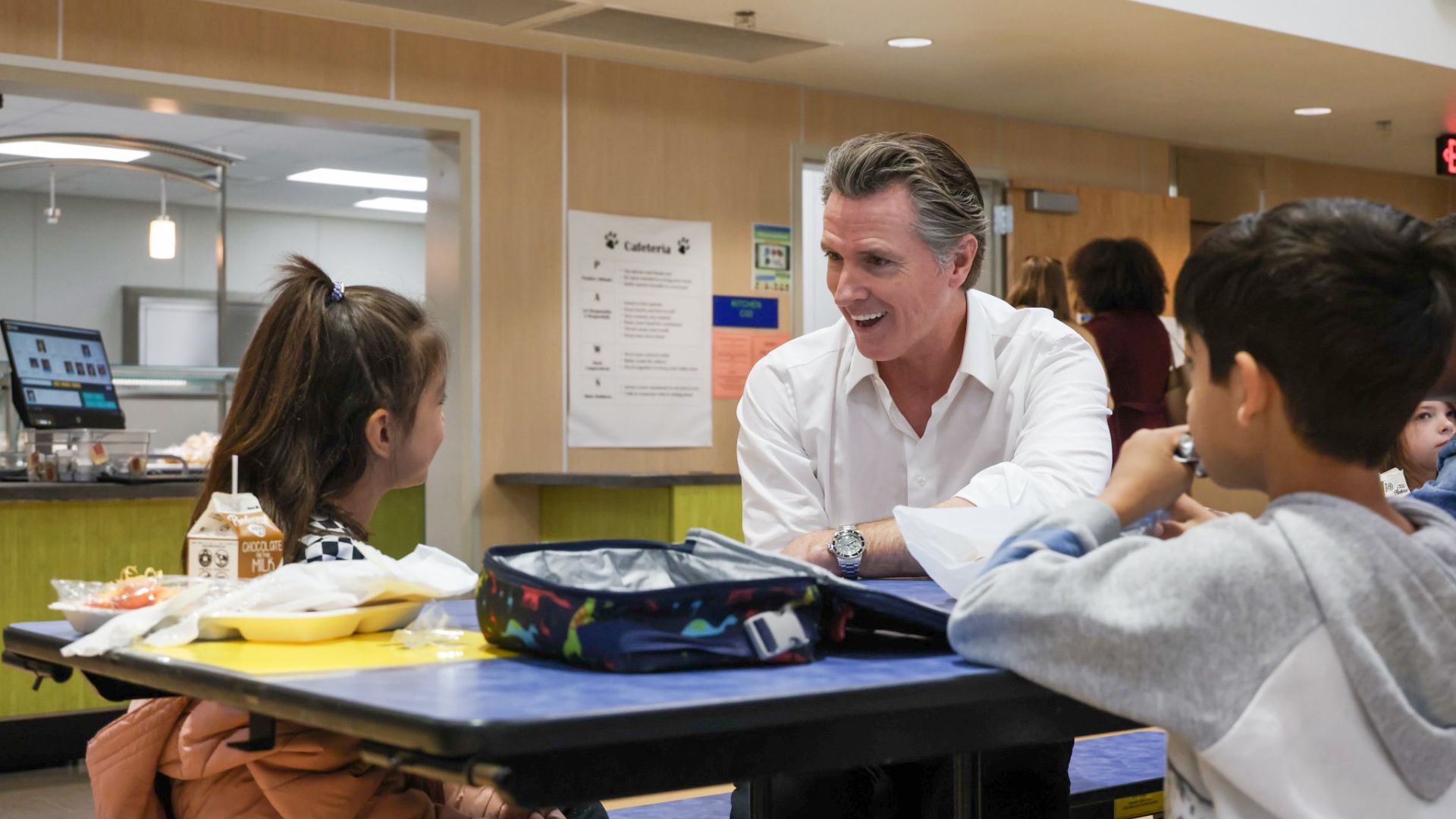

Sacramento, California – In California, a school meal has become more than a tray, a carton of milk and a place in line. It has become a statewide promise, simple on paper, massive in practice, and still sharply debated five years after Gov. Gavin Newsom signed the law that made California the first state in the nation to guarantee free school meals for every public school student.
The milestone is large enough to be hard to picture: nearly 3.5 billion meals served since the universal program took full effect in the 2022-23 school year. State officials say California is now expected to serve nearly 1 billion school meals in a single year, a number that captures both the scale of the effort and the size of the public investment behind it.
What California built
The policy began as part of the 2021 education budget package and became permanent after pandemic-era federal waivers showed what universal access could look like. Under California’s Universal Meals Program, public school districts, charter schools and county offices of education serving TK-12 students must provide one free breakfast and one free lunch each school day to any student who asks, regardless of family income.
The California Department of Education describes the program around three pillars: a statewide meal mandate, required use of federal provisions at high-poverty schools, and state reimbursement to cover costs not paid by federal programs. In plain language, that means schools still lean on federal meal programs, but California fills the gap so a child does not have to qualify as poor before eating at school.
Newsom framed the anniversary as proof of a broad public investment.
“Five years ago, I was proud to sign universal school meals into law,” he said, adding that the state is seeing “healthier kids, more resilient families, and expanded opportunities.” First Partner Jennifer Siebel Newsom called the program “a vital investment in our children and their future.”
Five years ago, I signed a piece of legislation into law making California the FIRST state in the nation to guarantee free school meals for ALL public school students.
Today, nearly 3.5 billion school meals have been served, creating healthier, more resilient families and kids. pic.twitter.com/GtYIqvAFCN
— Governor Gavin Newsom (@CAgovernor) June 27, 2026
The family savings argument
Supporters say the program removed one of the most visible lines between students: who could afford lunch and who could not. They also argue that California’s high cost of living makes old federal income limits too narrow for families living just above the cutoff.
That point is not small. The California Budget & Policy Center has reported that 44% of food-insecure families in the state had incomes above 185% of the federal poverty level in 2022, meaning many struggling households would have missed traditional free or reduced-price meal help.
The need remains real. KidsData reported that an estimated 1.43 million California children, or 16.9%, lived in food-insecure households in 2023, more than 1 in 6 children statewide.
Advocates also point to participation gains. School meal participation has increased by nearly 9% since implementation, with schools serving an estimated 73 million more meals annually compared with pre-program levels, according to the School Meals for All coalition.
The price tag on the tray
But “free” does not mean cost-free. The Legislative Analyst’s Office said the 2024-25 budget included $1.8 billion in Proposition 98 General Fund support and $2.7 billion in federal funding for a projected 884 million school meals. That works out to a rough combined reimbursement near $5 per meal, though actual rates vary by meal type and category.
Those numbers feed the criticism. Some Californians see the program as a clear safety net. Others see another expensive mandate in a state already wrestling with housing costs, taxes, homelessness spending and uneven school results.
The LAO has also noted that higher meal volume has increased budget pressure. The governor’s 2025-26 proposal included additional money to cover a school nutrition shortfall tied largely to revised meal projections, along with more funding for cost-of-living adjustments.
Quality remains the hardest test
Access is one victory. Quality is another fight.
California has invested in kitchen infrastructure, training and farm-to-school efforts meant to move cafeterias away from heavily packaged meals and toward fresher, locally sourced food. The LAO reported a proposed third round of Kitchen Infrastructure and Training funds, including $100 million for upgrades and $50 million for staff training or compensation, aimed at helping schools prepare more fresh meals on site.
Still, the daily experience varies by district. Some schools have used grants and local partnerships to improve menus. Others continue to face staffing shortages, food costs, supply chain problems and the practical challenge of feeding hundreds or thousands of students quickly.
That gap explains why the anniversary drew both praise and backlash. For some parents, free meals mean real savings and less shame. For critics, photos of packaged sandwiches or unappealing trays raise a blunt question: if taxpayers are paying billions, what exactly are children eating?
Bigger outcomes still unsettled
The program was never meant to solve California education by itself. Hunger affects learning, but it is only one piece of a much larger puzzle.
California’s 2024 NAEP results show why some critics remain skeptical of broad claims. PPIC reported that 29% of California fourth-graders and 28% of eighth-graders were proficient in reading, while math proficiency was 35% in fourth grade and 25% in eighth grade. California’s NAEP scores have long trailed national averages.
The fairest reading may be this: California has proven it can feed students at enormous scale. It has not yet proven that universal meals, by themselves, can move the state’s larger academic and health outcomes in a measurable way.
Five years in, the meals are still being served. The promise is still alive. But the next test is harder than counting trays. California now has to show that the food is good, the spending is disciplined, and the investment reaches beyond the cafeteria line.