

Sacramento, California – While much attention focuses on police spending growth amid declining crime metrics, Sacramento’s Fire Department has its own story of budget increases, staffing changes, and outcome questions, all unfolding under the same $66.2 million General Fund gap that shaped the FY 2026/27 Proposed Budget.
The City of Sacramento’s $1.7 billion total budget proposal, including an $898.3 million General Fund, closes that structural deficit through a mix of revenue enhancements, vacant position eliminations, and program efficiencies, with no sworn police or fire personnel laid off.
Yet the trajectories of the two largest public safety departments diverge in revealing ways.
The Sacramento Fire Department (SFD) operates with an annual budget of approximately $191 million and manages over 760 employees. In FY 2023/24 alone, it responded to 98,157 incidents, the vast majority medical in nature.
Meanwhile, the Police Department budget has ballooned to a proposed $255.7 million, more than doubling from roughly $125 million in FY 2015-16 even as authorized sworn positions declined from 740 to 699.
This parallel analysis examines whether fire faces similar or different dynamics under identical fiscal constraints, using line-item data from the FY 2026/27 Proposed Budget, department reports, and performance audits.
The numbers: Budget growth, staffing, and overtime pressures
The FY 2026/27 Proposed Budget reveals a department protected at its core but undergoing significant operational recalibration. Key among the balancing strategies is $3.6 million in ongoing savings from further implementation of the Fire Single Role program.
This initiative deletes 12 Firefighter positions while adding 20 new positions (10 Sacramento Fire Paramedic and 10 Sacramento Fire EMT), creating a net increase in specialized EMS capacity while aiming to improve recruiting pipelines and reduce the need for full engine companies on lower-acuity calls.
Additional adjustments include the deletion of 19 vacant Fire Suppression positions (offset by EMS fee revenues and dynamic staffing models) and targeted additions: two Firefighter (Admin) positions for Diversity, Outreach & Recruitment funded by a three-year Measure U grant ($338,620); one position each for Mobile Integrated Health and Mobile Crisis Unit; and two for the Emergency Medical Firefighter Medical Quality Assurance Team.
These additions, largely grant- or Measure U-supported, reflect an emphasis on specialized response and workforce development rather than across-the-board expansion.
Table 1: Fire vs. Police, Key Budget and Staffing Metrics (FY 2026/27 Context)
| Metric | Fire Department | Police Department |
| Approximate Annual / Proposed Budget | $191 million (recent annual); adjustments via Single Role savings $3.6M and EMS revenues | $255.7 million proposed (up significantly; ~102% growth since FY2015-16 from ~$125M) |
| Total Employees / FTE Context | Over 760 employees (primarily sworn firefighters + support) | ~830 total positions; 699 authorized sworn (down from 740); 138 vacancies noted late 2025 |
| Proposed Staffing Changes | Delete ~19-20 vacant suppression positions; net +8+ specialized sworn via Single Role; +6-7 admin/specialized (grant-funded) | Significant reductions in vacant and some non-sworn; no sworn separations (reassigned); Magnet Academy partial restoration |
| Overtime / Efficiency Notes | Hospital ‘wall time’ excess ~7,000+ hours in FY24 costing ~$970k in non-productive labor; Single Role aims to optimize | OT historically used to cover vacancies; budget growth factors include salaries, pensions, OT, technology |
| Core Protection in Budget Gap | No sworn separations; dynamic staffing; EMS revenue offsets | No sworn separations; focused enforcement investments amid crime declines |
Sources: City of Sacramento FY2026/27 Proposed Operating Budget; department staffing data; CapRadio and news reports on adopted changes.
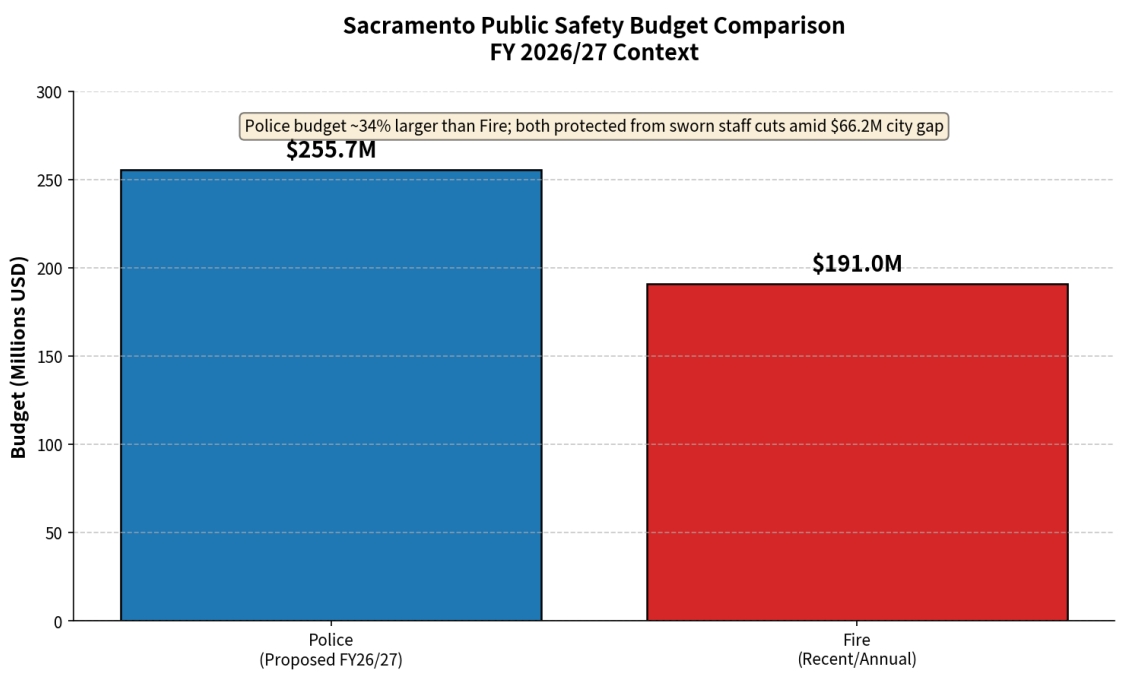
Figure 1: Comparative scale of the two departments’ budgets under the shared fiscal constraints of the $66.2 million gap closure. (Police budget is approximately 34% larger than Fire.)
Over the past decade, public safety labor costs, driven by step increases, pension contributions (CalPERS normal cost and UAL), and benefits, have been a primary driver of structural deficits for the City. The Fire Department’s Single Role program represents a targeted attempt to decouple some EMS demand from traditional suppression staffing models, potentially freeing engine companies and reducing overtime pressure from constant staffing or hospital delays.
Outcome metrics: Response, call volume, and prevention
SFD responded to 98,157 incidents from July 2023 to June 2024, according to a city auditor’s review of the Emergency Medical Services division. Nearly 40% were classified as “low-acuity”, posing no immediate threat to life, health, or property. This aligns with national trends where fire-based EMS systems handle 70-80% or more medical calls. The volume equates to roughly 269 incidents per day on average, placing sustained pressure on unit availability and crew readiness.
Performance challenges are documented in the EMS audit. The Sacramento Regional Fire/EMS Communications Center (SRFECC) has struggled to consistently meet call-answer benchmarks (goal: 90% within 15 seconds). Turnout times aim for NFPA 1710 standard of 60 seconds 90% of the time but face variability. Most critically, “wall time”, the period apparatus and crews wait at hospitals to offload patients, created over 7,000 excess hours in FY 2024 beyond the 30-minute threshold, at an estimated non-productive labor cost of $970,000. Average excess wall time was approximately 21 minutes per patient, directly reducing the hours available for emergency response elsewhere in the city.
Key Performance Indicators (FY23/24 – FY26/27 Context)
- Incident Volume: 98,157 total incidents (FY23/24); ~40% low-acuity. Trend: Increasing medical demand consistent with regional and national patterns.
- Staffing Impact: Single Role EMT/Paramedic program (12-hour shifts, 3-on/3-off) deployed from fire stations to handle dedicated ambulance responses, improving pipeline for full firefighter-paramedics and potentially reducing engine commitments on non-fire calls.
- Prevention & Revenue: Fire Prevention permit and code enforcement fees revised upward in proposed budget, contributing to revenue offsets. However, public data on inspection completion rates, violation corrections, or fires prevented remains limited.
- Readiness Drain: Hospital wall time represents a measurable drag on system capacity equivalent to multiple full-time unit equivalents lost annually.
- Recruitment Focus: Grant-funded diversity/outreach positions and Single Role hiring pathway signal proactive response to nationwide firefighter/paramedic shortages.

District/neighborhood variations and budget trade-offs
Publicly available data on geographic variations in call demand, response times by first-due district, or resource allocation equity is sparse. High-density or higher-poverty neighborhoods likely generate disproportionate medical call volumes, raising questions about whether current station deployment and dynamic staffing models adequately address disparities in arrival times or unit utilization. The absence of a public-facing performance dashboard, common in peer cities, makes independent analysis of neighborhood-level outcomes difficult.
Within the public safety envelope, trade-offs are evident. The Fire Department’s efficiency measures (Single Role savings, vacant deletions offset by EMS revenues) allowed protection of core suppression capacity while contributing to gap closure.
Police reductions focused more heavily on non-sworn and vacant roles, with investments preserved in targeted enforcement. Both departments avoided sworn layoffs, consistent with Council and public priorities. However, these choices came against cuts elsewhere: parks maintenance, youth programs, and other General Fund services.
The $66.2 million gap closure relied on approximately $72.8 million in strategies, with public safety contributing through efficiencies rather than deep service reductions.
Data gaps in outcome tracking
A consistent theme across both departments is the incompleteness of publicly accessible, standardized outcome data that would allow rigorous evaluation of return on investment:
- Response time compliance (e.g., 90th percentile total response time by incident type and district) is not routinely published in an easy-to-access annual report or dashboard for SFD.
- Overtime hours and costs are not broken out clearly by department in high-level budget documents, obscuring the true marginal cost of vacancies and hospital delays.
- Prevention metrics (inspections completed vs. planned, false alarm reduction, fire loss statistics correlated with prevention activity) lack longitudinal public tracking.
- Patient outcome proxies or system utilization rates (e.g., unit hour utilization, fractile response performance) are referenced in internal audits but not systematically trended for policymakers or the public.
- Staffing-to-demand modeling (how many suppression and single-role units are needed given projected call volume growth and wall time) is not transparently modeled in budget materials.
These gaps hinder the ability to move from anecdote or single-year snapshots to evidence-based budgeting. For a department handling nearly 100,000 incidents annually with a $191 million price tag, the lack of routine, comparable performance reporting represents a transparency shortfall parallel to concerns raised about police metrics.
Painful cuts in a difficult budget cycle
Sacramento’s Fire Department, like its police counterpart, has been shielded from the most painful cuts in a difficult budget cycle. Its story, however, is less about headcount reduction and more about adaptation to a call volume dominated by medical emergencies, hospital system frictions, and the search for sustainable staffing models through Single Role innovation.
Budget growth over the decade has been real for both, police dramatically so, but the underlying drivers and measurable returns differ.
The parallel scrutiny reveals a shared need: consistent, public-facing outcome metrics that link dollars and staffing to results.
Without them, debates over “enough” or “too much” spending remain partly ideological rather than data-driven. The Single Role program deserves close monitoring for its impact on engine availability, recruiting success, and overall system cost-effectiveness.
Hospital wall time mitigation, whether through policy, additional resources, or system partnerships, is a high-leverage opportunity to reclaim capacity without new hiring.